
Nobody brags about their CI/CD pipelines at a board meeting. But when deployments break production on a Friday afternoon, everyone suddenly cares very much.
DevOps infrastructure is the unglamorous foundation that everything else depends on. And for most businesses, it’s under-engineered, under-resourced, and managed by developers who have other jobs to do.
Outsourcing DevOps gives you access to certified infrastructure engineers without the 60-day hiring cycle and the $180,000 salary commitment. According to Gartner, 75% of organisations will adopt a DevOps culture by 2027, yet the talent gap keeps widening.
The businesses closing that gap aren’t waiting for the market to fix itself. Here’s how they’re doing it.
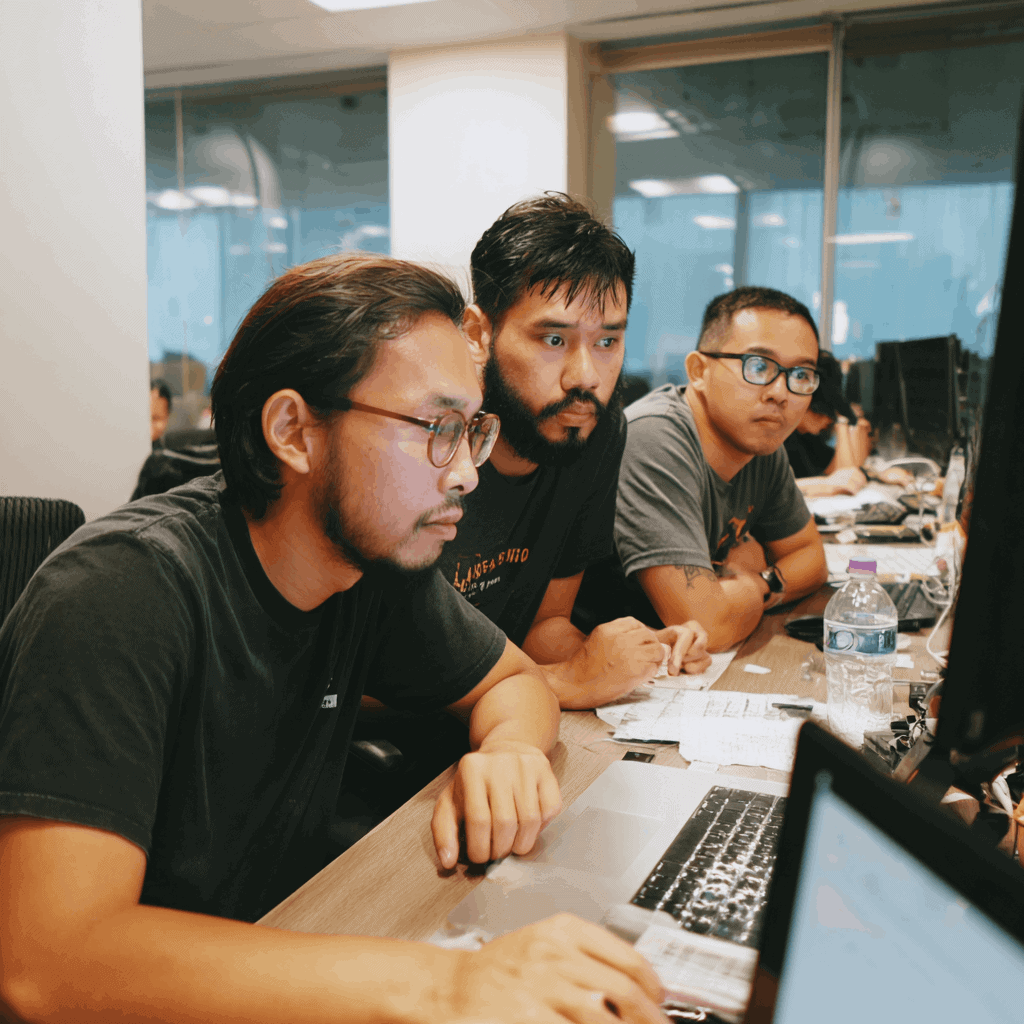
Outsourcing DevOps is engaging external engineers to design, build, operate, and optimise your software delivery and infrastructure systems.
The outsourced team manages the engineering functions that sit between your development output and your production environment:
- CI/CD pipelines
- Cloud infrastructure
- Containerised orchestration deployment
- Monitoring
- Security controls
- Incident response
This is distinct from managed services, where a vendor operates predefined infrastructure under a service agreement.
In outsourced DevOps, engineers work within your technical environment, contribute to your codebase and infrastructure configuration, and operate under your architectural standards.
You also retain ownership of the infrastructure and the intellectual property (IP). The offshore team provides the specialist engineering capability to build and run it properly.
Outsourced site reliability engineering (SRE) pods take this further. They assign dedicated SRE specialists to your production environment with defined reliability targets, incident response protocols, and continuous improvement mandates.
The pod operates as a functional extension of your engineering organisation rather than an external support service.
Why Companies Outsource DevOps
The decision to outsource DevOps makes cost benefits a secondary outcome:
You Access Certified Specialists Immediately
Building an internal DevOps team requires recruiting engineers with specific certifications and production experience in your cloud environment of choice.
That process takes months in competitive hiring markets and frequently fails to produce the depth of specialist knowledge the role requires.
An outsourced DevOps provider fields engineers who are already certified, already experienced with your platforms, and already operational. The ramp-up time, measured in weeks rather than quarters, changes what your infrastructure roadmap can realistically deliver.
Cloud Infrastructure Cost Optimisation Becomes Systematic
Most organisations significantly overspend on cloud infrastructure because no one has the time or specialisation to continuously audit resource utilisation, right-size deployments, and eliminate idle spend.
In fact, Cloud Zero found that only 30% of organisations know where their cloud spending goes.
Outsourced DevOps engineers make cloud infrastructure cost optimisation a standing operational discipline rather than an occasional project.
Your Engineering Team Stops Carrying Infrastructure Burden
When developers manage their own infrastructure, deployment pipelines, and incident response alongside feature development, all three suffer.
Outsourcing DevOps creates a clean separation of concerns. Your product engineers build features. Your outsourced DevOps team owns the infrastructure and delivery systems. Developer productivity improves because the cognitive overhead of infrastructure management is removed from people whose primary value is in the product.
Enterprise Cloud Security Architecture Gets Built in Correctly
Security controls in cloud infrastructure are most effective when they’re designed into the architecture from the foundation, not retrofitted after.
Outsourced DevOps engineers who specialise in enterprise cloud security architecture implement identity and access management, network segmentation, secrets management, and compliance controls as structural components of your infrastructure.
The cost of remediating a poorly secured cloud environment consistently exceeds the cost of building it securely from the start.
You Get Operational Maturity Your Business Hasn’t Earned Yet
Operational maturity in infrastructure, the practices, processes, and tooling that separate stable production environments from fragile ones, takes years to accumulate internally.
Outsourced DevOps teams bring this maturity from day one because they’ve earned it across multiple client environments. Your business inherits the benefits of operational experience you haven’t had the time or incidents to develop yourself.
Core Services Provided by Outsourced DevOps Teams
A comprehensive outsourced DevOps engagement covers the full infrastructure delivery and operations lifecycle.
- Secure CI/CD Release Automation. Outsourced engineers design and maintain automated build, test, and deployment pipelines that release software reliably and securely. Pipeline configurations enforce security scanning, test coverage gates, and approval workflows before any code reaches production.
- Containerised Orchestration Deployment. DevOps teams build and manage Kubernetes or equivalent container orchestration environments that run your applications consistently across development, staging, and production. Container infrastructure reduces environmental inconsistency and simplifies scaling without manual intervention.
- Cloud Infrastructure Provisioning and Management. Outsourced teams provision and manage cloud environments across AWS, Azure, and GCP using infrastructure as code, ensuring that every environment is reproducible, version-controlled, and auditable. Cloud resource management includes cost monitoring and continuous right-sizing.
- Monitoring, Observability, and Alerting. DevOps engineers implement comprehensive observability stacks covering application performance, infrastructure health, log aggregation, and distributed tracing. Alert configurations are tuned to reduce noise while ensuring genuine incidents surface immediately.
- Incident Response and On-call Engineering. Outsourced SRE pods provide structured on-call coverage with defined response time targets and incident management protocols. Post-incident reviews feed systematic reliability improvements rather than one-off fixes.
- Security and Compliance Engineering. DevOps teams implement and maintain cloud security controls, including vulnerability scanning, secrets management, network security policies, and compliance documentation for frameworks including SOC 2, ISO 27001, and the Australian Essential Eight.

6 Engineering Frameworks When Outsourcing DevOps
High-performing outsourced DevOps teams apply specific engineering frameworks that separate mature infrastructure operations from ad hoc management.
1. Managed Infrastructure as Code Pipelines
Infrastructure as code (IaC) treats your cloud environment configuration the same way your application team treats software: version-controlled, peer-reviewed, and deployed through automated pipelines.
Managed IaC pipelines ensure that every infrastructure change passes through a review and testing process before it reaches production, eliminating the manual configuration changes that create inconsistency and audit gaps.
Terraform, Pulumi, and AWS CDK are the primary tools in this category, and experienced outsourced DevOps teams maintain production-grade IaC pipelines that your internal team can inspect and contribute to, rather than black-box configurations they can’t understand or modify.
2. Ephemeral Bastions
Ephemeral bastions replace persistent jump servers, which represent a continuous security exposure. These have on-demand access instances that exist only for the duration of an authorised session.
When an engineer needs to access a production environment, an ephemeral bastion spins up, grants time-limited access, logs every action, and terminates completely when the session ends.
This architecture eliminates the standing attack surface that persistent access points create without restricting the legitimate access your operations team requires.
3. Configuration Drift Mitigation
Configuration drift occurs when your production infrastructure gradually diverges from its defined state through manual changes, failed updates, or undocumented interventions.
Drift creates unpredictable behaviour, security gaps, and environments that can’t be reliably reproduced.
Outsourced DevOps teams implement continuous drift detection tooling that compares your actual infrastructure state against your IaC definitions and either automatically remediates divergence or alerts engineers to review it before it compounds.
4. GitOps Workflow Architecture
GitOps treats your Git repository as the single source of truth for both application and infrastructure state. It uses pull request workflows and automated reconciliation to ensure that what’s in your repository matches what’s running in production.
This architecture makes every change to your environment traceable, reversible, and auditable through standard version control tooling.
5. Chaos Engineering and Resilience Testing
Chaos engineering deliberately introduces controlled failures into your production or staging environment to identify resilience weaknesses before uncontrolled failures expose them to your users.
Outsourced SRE teams design and execute structured chaos experiments, including network partitions, instance terminations, and latency injections, that prove your system’s reliability under adverse conditions rather than assuming it.
The findings from these experiments feed a prioritised reliability improvement backlog that systematically reduces your mean time to recovery across your most critical services.
6. Policy as Code Enforcement
Policy as code embeds your security, compliance, and operational standards directly into your infrastructure delivery pipeline as automated checks that block non-compliant configurations from reaching production.
Tools like Open Policy Agent or AWS Config Rules evaluate every infrastructure change against your defined policies before deployment. As a result, this eliminates the manual compliance review cycles that slow releases and the human error that makes them inconsistent.
How to Start DevOps Outsourcing
Starting a DevOps outsourcing engagement produces the best results when the foundation is set correctly before any infrastructure work begins.
- Audit your current infrastructure state. Document your existing cloud environments, CI/CD tooling, deployment processes, and known reliability issues before engaging an external team. An accurate current-state picture allows the outsourced team to prioritise effectively rather than discover problems reactively.
- Define your reliability and security requirements. Specify your availability targets, recovery time objectives, compliance frameworks, and security standards before the engagement begins.
- Clarify IP ownership and access governance in the contract. All infrastructure code, pipeline configurations, and architecture documentation produced during the engagement must be contractually owned by your organisation.
- Start with a bounded infrastructure workstream. Begin the engagement with a specific, scoped infrastructure project rather than handing over your entire environment simultaneously.
- Establish observability before optimisation. Ensure your monitoring and logging infrastructure is in place and producing reliable data before beginning performance or cost optimisation work.
- Define escalation paths for production incidents. Establish who in your organisation is the decision-maker for production incidents, what the outsourced team’s authority is to take remediation actions without prior approval, and what communication cadence you expect during an active incident. Clarity here prevents costly delays during the situations that matter most.
Work with Certified Infrastructure Engineers
The gap between a functional DevOps team and a high-performing one is the difference between infrastructure that just runs and infrastructure that runs reliably, securely, and at the cost it should.
That gap is engineering quality, and engineering quality is determined by the people you put on the problem.
We at Outsourced Staff can place you with certified DevOps engineers, cloud architects, and SRE specialists who bring production-proven expertise in the frameworks and platforms your infrastructure requires.
Whether you need a dedicated SRE pod, a CI/CD pipeline rebuild, or an ongoing cloud infrastructure partner, we source and place pre-vetted talent that integrates into your engineering organisation and delivers the operational maturity your production environment deserves.
FAQs
What is the difference between outsourcing DevOps and managed DevOps services?
Managed DevOps services provide predefined infrastructure management under a vendor service agreement, where the vendor operates your systems to a defined SLA but retains control over the tooling and processes.
Outsourcing DevOps places engineers directly within your technical environment, working to your architectural standards, contributing to your codebase, and building infrastructure that your organisation owns and controls.
How much does outsourcing DevOps cost compared to hiring internally?
A senior DevOps engineer in Australia commands up to $200,000 in base salary, with total employment cost including superannuation, recruitment, and tooling. Outsourced DevOps engineers through an offshore provider typically cost up to 70% at equivalent seniority levels.
How do you maintain security when outsourcing DevOps access to production environments?
Production environment security in outsourced DevOps engagements requires:
- Role-based access controls scoped to each engineer’s specific responsibilities
- Multi-factor authentication on all access points
- Comprehensive audit logging of every action taken in production
- Use of ephemeral bastion architecture that eliminates persistent privileged access
Outsourced DevOps teams operating within well-designed access governance frameworks carry no greater security risk than internal teams, and often less, because the access controls are explicitly defined rather than accumulated informally over time.

Dom Procter is a 30-year tech veteran and outsourcing specialist, and the driving force behind Outsourced Staff and Conversational AI. He’s obsessed with one thing: helping businesses grow smarter by combining elite offshore talent with cutting-edge AI – the Hybrid AI model that’s redefining how modern teams operate.